- 01The value of 10Clouds Agile Delivery Method vs other approaches
- 0210C Agile Delivery Method overview
- 03Fundamentals
- 0410C Product lifecycle overview
- 05Product Delivery - Roles and responsibilities
- 06Product Delivery Toolbox
- 07Setting up your product for success - how to start working with 10Clouds on your product
- 08Summary
What you will learn
 Devising the product approach to fit the market besthow to turn your product idea into market reality
 Organising the work to get resultshow to set up delivery work in a transparent and efficient way, with quick time-to-market in mind
 Efficient kick-off of the workusing the team's full ability to develop your product
 Getting the right qualityhow to integrate quality into product delivery
About the authors

Urszula Wawrzeniuk
Head of Product Delivery at 10Clouds
Practising Agile Lead who helps businesses create sustainable value to customers. She specialises in an agile approach, facilitation, creating agile environments in organisations, project and team leadership. She is an experienced facilitator, business trainer and consultant.

Wiosna Wiłkomirska
Agile Coach and Product Delivery Manager
Experience in advisory and implementation projects dating back to 2008. She has supported management and teams in understanding and applying the Agile values and practices. Currently creates and implements standards for efficient delivery of valuable products, provides mentoring for Product Delivery Managers as well as Agile Coaching for clients.
Contributors

Maintenance Engineering Manager, 10Clouds

Senior Account Executive, 10Clouds

Product Delivery Manager, 10Clouds

Product Delivery Manager, Presales Lead, 10Clouds

Product Delivery Manager, 10Clouds

Product Delivery Manager, 10Clouds
How our Product Delivery Method helped our clients
“(...) their project management was excellent. They were very communicative and offered valuable suggestions. There was a continuous feedback loop.”
Global Acounting Firm
Introduction
Successful products have one thing in common: a method for creating and refining their scope, as well as a disciplined, value-driven way of delivering them. In this playbook, we will explain what the product delivery process at 10Clouds looks like and the benefits that it can bring your business - beginning with successful product launches. We will clearly explain the goals and value of every phase, the roles and responsibilities of the people involved, the tools and methods used and the level of engagement needed from your side to effectively collaborate in product creation.
In our approach, we draw heavily from well-established frameworks including Scrum and Kanban. Putting our many years of experience to good use, we integrate them with our best practices around external collaboration, working in a remote environment and managing distributed teams. Because we are agile, we can respond quickly to changes, allowing you to control the delivery process.
“Product Delivery is at the heart of our business. We are reliable partners throughout the whole product lifecycle, supporting our customers to build products and services that deliver real value to their end users and achieve market success”
Michał KłujszoHead of Delivery, 10Clouds

The value of 10Clouds Agile Delivery Method vs other approaches
Over the last two decades, Agile approaches have continuously proven to be more efficient in software delivery than previous methodologies such as Waterfall.
Here are just some of the benefits that you reap from Agile working:
- Higher rates of successful product delivery
- Shorter time to market
- Better product quality
- Adapting the product to changing market/user needs
- Increased customer/end-user satisfaction
- Increased project transparency
- Easier risk management
A lot of these benefits will also bring down your product's Total Cost of Ownership (TCO).
To make sure that our clients also benefit from Agile, we draw inspiration from leading frameworks such as Scrum and Kanban. A number of elements (such as sprints or kanban boards) have become part of our DNA and are present in our daily work.
However, at 10Clouds we felt the need to make the delivery approach more product-centric and put the focus on delivering value rather than delivering scope in a project-like fashion. This is the basis of the 10C Agile Delivery Method.
Therefore, we believe that 10Clouds Agile Delivery Method serves our clients better. Below are just some of the ways in which:
Applying the 10C Agile Delivery Method and utilizing reusable components can increase the product launch success rate.
The product value focus and continuous discovery
We have made sure that good product management practices are at the core of the Delivery Model. This helps us ensure that the features we work on are focused on bringing real value to users and that product management is a continuous process - throughout the whole product lifecycle.
Flexibility while drawing from best industry practices
We have taken the elements that we found to be the most useful ones from the various frameworks and practices, and combined them in one model. We have also included our experience and best practices that we have developed over the years as a software house.
PDM as a delivery partner
To better support the product-centricity of our delivery process, we have replaced the Scrum Master role with a broader Product Delivery Manager role. This way we can better support product management and act as a delivery partner, rather than concentrating solely on the team and the delivery process.
Project health framework
In all our projects, we want to be transparent and proactive in risk management, making sure any issues are dealt with quickly. Our project health framework, including measures like delivery health, client satisfaction and team satisfaction ensures that any quality risks can be flagged early on.
10Clouds Enabling Team (Tech Hub)
The Enabling Team consists of Tech Leaders who help set up projects, facilitate technical discussions and help to ensure that the technical standards are met throughout the project. The goal is to create an environment that fosters development teams’ autonomy rather than supervise their work.
A combination of agile methodology with a product-centric angle reduces risks and supports effective product launches, which inspire confidence.
10C Agile Delivery Method overview
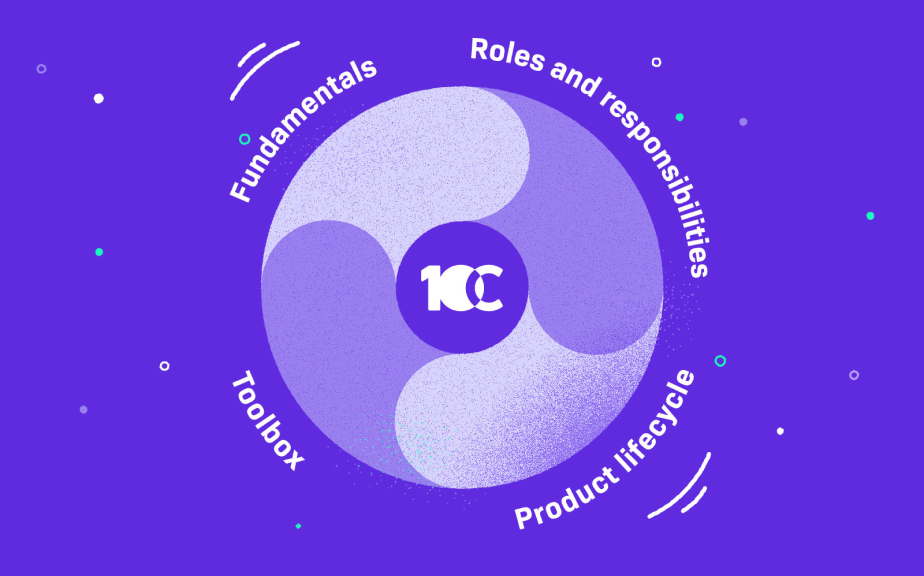
Fundamentals
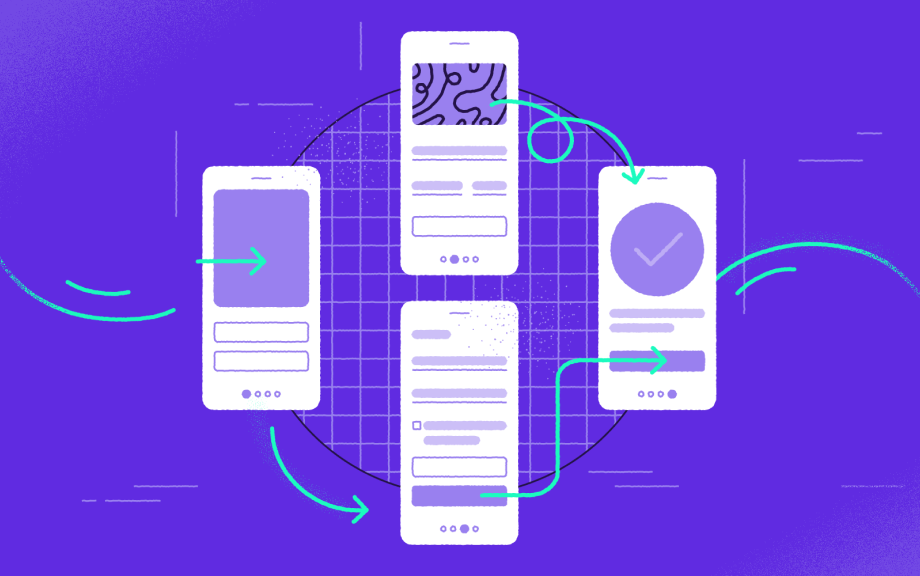
10Clouds Product Delivery is:


Delivery Manifesto
Delivery Manifesto
Product delivery
over project delivery
Flexibility in action
over defined roles
Trust and accountability
over low-level management
Delivering value
over delivering scope
Extreme ownership
over areas ownership
Competencies
over processes
Focusing on product over project delivery and value over scope puts us in a strong position to build successful products with our customers.
10C Product lifecycle overview
We are aware that creating a successful product does not start with development. A good outcome most often results from first understanding the market, the problem space and the product-market fit.
Then, development itself requires a different approach depending on the business maturity of your product. Also, once the product is out there, it needs to be maintained, supported and kept in good health.
Our team is fully aware of what needs to be done at every stage of product delivery. We work with companies that are at every stage of product maturity and we can support our clients with their unique needs.
We use the 10C product delivery lifecycle as a starting point for working with our clients. At the initial stages of our cooperation, our Presales team will spend time understanding:
your business needs and goals
the biggest challenges you’re facing right now
the current status of the product
your time to market expectations
Thanks to this we know exactly which phase of the lifecycle your product is in, and we can offer you the scope and intensity of engagement that is right for you.
You can find the full product lifecycle overview below.
Taking consecutive steps and anticipating what will be needed at the current and next stages of the product lifecycle helps you minimize risk and increase your chances of success.
Product lifecycle overview - 01
Insight Stage
This is the starting point for customers who have a general product idea. This phase is about verifying assumptions and creating a product strategy before investing in development.
Overview
During this stage the team (which involves both you - the client and 10Clouds) will work on understanding the problem space (through analysis, research, expert input, etc.) and will collaboratively define the product strategy.
Goal
In this stage, we aim to understand the market in general and define the product strategy based on the insights from our research.
Value
Creating a successful product is not possible without understanding the problems we want to solve. The Insight stage helps us identify those problems and set a direction for the product.
Initial verification of clients’/users’ needs and problems and defining personas is the first step to understanding what a valuable product can look like.
You gain a business partner instead of a (purely technical) delivery partner.
10Clouds approach
The Insight phase is built around workshops and research. Most of the exercises used by consultants, such as Wardley Mapping, can also be used by 10Clouds.
The duration of the Insight Phase depends on the product complexity and the need for research. On average, it takes 2-4 weeks.
A good understanding of the product’s value to customers increases the chances of a better market fit and increases the product’s chance of success.
Product lifecycle overview - 02
Discovery Stage
This is a starting point for customers who have already defined their product strategy and want to proceed with building a prototype.
Overview
During this stage the team (which includes you - the client - and 10Clouds) undertakes to test the ideas from the Insight stage by creating a prototype that includes the core product features and user flows.
Value
Full-fledged products are expensive to make and have a high chance of failing as they may not deliver what the market needs. Building a prototype before the main development stage allows us to test the assumptions and increase the chances of getting the final product right.
This phase lets clients validate the value of the entire solution as well as the value of particular features.
This is also a chance to get initial hints from the users on the UX side which can be later used when building the actual product.
You gain the opportunity to make changes and serve a real need in the market.
With prototypes, you gain a valuable tool that you can use to attract investment.
Confirming your assumptions is great for morale and can give you the motivation to keep going when the going gets tough.
10Clouds approach
This stage consists of workshops, research and design/development activities aimed at creating prototypes of the product.
The duration of the Insight Phase depends on the product complexity, required research and the number and complexity of prototypes to be created.
Deliverables
Market testing that includes prototyping, user validation and UX analysis prior to the full development stage significantly reduces the risk of delivering products that don’t work for the intended market.
Product lifecycle overview - 03 & 04
Product Delivery - Introduction and Growth Stages
In line with the principles of Lean and Agile, we strongly advise our clients to split the delivery of a product into several releases. The first release is usually a Minimum Marketable Product (MMP).
MMP is the first version of a product that can be released to the market as a proper product. It has enough features to satisfy early customers and provide feedback for further development.
The product roadmap (MMP and beyond) and initial backlog, based on the needs identified in the earlier stages of the lifecycle, are defined by the Product Owner (which might be also a decision-making team on your side). We advise our clients to plan the subsequent releases based on evidence from the market, i.e. user feedback, rather than assumptions.
We believe that product management activities should be data-driven (which is why we will help you define your Key Performance Indicators) and continuous, making the evolution of the product continuous.
Goal
The goal is to deliver your product - first in the MMP version and then in further releases, based on your product strategy.
The goal of the MMP is to:
put the product on the market and monetize it
create a customer base
gather feedback about the product and its further development
Following the MMP, the focus usually is on those areas:
Increasing stability and scalability - making it robust and ready to grow
Developing an enhanced version through a series of iterations
Creating your own IP
Why do we recommend splitting into releases and starting with an MMP?
Less time to launch
Building an MMP for a product is finding the sweet spot between the minimum amount of work and the highest value, so it takes less time to launch compared to building a full-fledged product from scratch.
Less room for error
With the work split into smaller chunks, teams can test the solution earlier and get feedback from the market, allowing them to iterate and improve as they progress.
Budget-friendliness
An MMP makes it more affordable to start a business.
A chance to find investors and raise funding
An MMP can showcase the seed of what is expected to grow into a fully-fledged product, a good selling point for attracting investors.
Establishing a customer base
Another reason behind developing an MMP is to make it available to the first set of real users who will help test the product and provide valuable feedback.
How do we organise the software delivery of the MMP and beyond?
10C Product Delivery is Agile - we draw from the Agile Manifesto and the leading agile frameworks, predominantly Scrum and Kanban, to combine them with our best practices to support effective delivery.
To ensure the quality of our collaboration with clients, we have a company-wide project health process so the organization has visibility about each and every project.
We have also defined standards and practices for Product Delivery Managers to ensure that in all projects they cover the following areas:
Product (backlog) management
Product quality
Delivery process quality
Communication and Transparency
Team building
Formalities and procedures
Project onboarding
In this phase, the Product Delivery Manager (PDM) liaises with you on the methods of collaboration. The kick-off of a project may take different forms depending on the scope and phase of the project.
Product delivery
The delivery can be based on Scrum (with sprints - fixed-length events aimed at delivering a product increment) or a more Kanban-like approach (with a continuous flow of work items without a fixed timebox). We will assess the best model during project onboarding - usually, we recommend starting with Scrum and then adjusting to the situation.
The Product Owner on your side will manage the product roadmap and backlog, with the PDM’s support (we call the PDM a delivery partner because of their broad support in the delivery process).
In projects that cover both design and development, especially ones that require heavily customised user interfaces, we may start with the Design phase first, so that the team can build the product based on the UX/UI design.
However, we may advise our clients to start at the same time, especially if the user interface is simple and the design will not take a lot of work.
Work cadence
Usually, we’re working in 2-week sprints, but depending on the specific product situation, the client’s preferences and team composition, we can adjust.
Day 1
Daily meeting
Review, Retro, Planning
Day 2
Daily meeting
Day 3
Daily meeting
Product roadmap & backlog management (PO, Tech Lead, PDM)
Day 4
Daily meeting
Day 5
Refinement of backlog for next sprint(s)
Day 6
Daily meeting
Day 7
Daily meeting
Day 8
Daily meeting
Day 9
Daily meeting
Day 10
Daily meeting
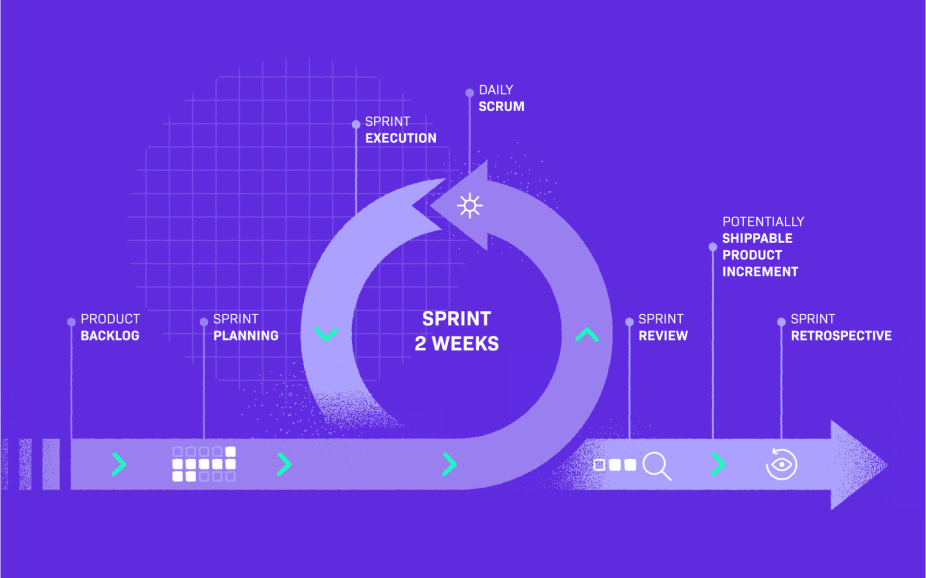
At the end of the sprint, a new potentially shippable product increment is created and the client can review the team’s work.
During planning, the team and Product Owner discuss what the next sprint’s goal should be and what work needs to be done to deliver a product increment.
The team inspects its progress towards the sprint goal during daily meetings and uses that information to adapt its plan if needed.
The results of the work are presented in the review stage, which is also an opportunity to gather input on what to do next.
The team then uses the retrospective meeting to discuss improvements to see how they work together and can do better.
During the sprint, we organize meetings dedicated to reviewing the roadmap and the backlog for the upcoming sprints, which is our take on product management activities.
Progress tracking
Usually we use Jira for backlog management and defining the product backlog items (user stories, tasks etc.) and their statuses.
In Jira, you will be able to see the status of individual backlog items as well as of the whole sprint.
On top of that, you can expect the PDM to provide you with updated information about the progress and any blockers or risks that need attention.
Project Health
All our projects are covered by the Project Health process which includes the following metrics:
Delivery Health: scope, budget, time
Client satisfaction
Team satisfaction
Risks
In case of any issues, the PDM and Account Manager, together with the assigned Project Owner from the 10Clouds management team, will work together to solve them as quickly as possible.
Quality assurance
We have a holistic view of product quality that encompasses several aspects:
Definition of Done
For all the points above - the task must meet the Acceptance Criteria
Differences between Introduction and Growth delivery models
The delivery process remains the same in Introduction and Growth phases, however there are some differences between the two:
Split the product into releases and start with a Minimum Marketable Product to make money earlier and reduce risk.
Product lifecycle overview - 05
Maintenance
After a product go-live that covers all currently required features, 10Clouds can support its ongoing functioning by moving it to a Maintenance phase.
The goals are:
To keep the product in good shape so that it continues to satisfy clients and remain competitive
To address market needs by small adjustments that let customers use a good quality product over a long period of time
proactively managing infrastructure to manage the costs and performance
During the maintenance phase, we advise our customers to gather user feedback and actively verify if the customers are still satisfied with the product and whether it still serves the market needs or whether a new round of development is needed to address those changes.
The monitoring scope can cover various types of monitoring services to quickly fix any availability issues - for example server monitoring, database monitoring, etc.
Handover to 10Clouds Maintenance Team is a defined process that ensures proper knowledge and documentation transfer to the maintenance team.
Together with your Account Executive / Account Manager, you will be able to define the scope and level of support together with the associated SLAs.
A good maintenance setup allows you to keep the product on the right track and enables further growth when needed.
Product Delivery - Roles and responsibilities
Since our approach is rooted in Agile values and principles, the core of 10Clouds product delivery is a cross-functional, self-managing team. 10Clouds, however, supplements this with key support roles and organisational support that help you navigate challenges effectively.
You will collaborate with:
The Development Team
(Usually: developers, QA, QAA, designers, Devops) that is responsible for delivering the product increment. We compose the team based on the needs of each project, making sure the right competencies are covered.
Tech Lead
For all projects, we provide the development team with the support of a senior developer who takes on the Tech Lead role. Tech Lead is responsible for the technical direction of the project, the quality of the code and the architecture.
A Product Delivery Manager
Who will, from 10Clouds’ side, drive efficient delivery of a valuable product. PDM’s primary areas of work include process management, communication, collaboration facilitation, stakeholder management, delivery support, risk management and more.
Account Manager / Account Executive
Who will deal with all contractual matters and ensure smooth business operations as part of the cooperation.
Additionally, the team will have access to the Tech Hub - Enabling Team composed of Tech Leaders who provide support to teams from across the company in maintaining code quality, best practices, security and performance as well as innovation.
From your side, we need a Product Owner, subject-matter experts as well as ensuring that the assigned stakeholders are available for key project meetings.
Our understanding of the Product Owner is derived from the Scrum Guide: the Product Owner is accountable for maximizing the value of the product. They also manage the product backlog, representing the needs and expectations of end users.
10Clouds’ PDM will be a partner for the PO in product management. For example, a PDM can take care of product backlog management, consult on the product strategy and roadmap, facilitate workshops and bring in experience from projects across different industries.
Product Delivery Toolbox
We use a set of best practices and standards in our daily work to make sure that our projects are run to the same high level that our clients expect from us.
In addition, 10Clouds Product Delivery Managers work together as a team to increase their knowledge and to contribute their best practices, experience and other resources.
To support our PDMs in their daily work, we have accumulated a plethora of tools and techniques for individual areas:
Product management toolbox, incl. discovery techniques, prioritization techniques, tools like Story Mapping, Impact Mapping, Lean Canvas, Lean Inception
Workshops and project meetings facilitation toolbox
Team collaboration toolbox
Project Health metrics toolbox, incl. risk management
And others
Setting up your product for success - how to start working with 10Clouds on your product
Our Sales and Presales teams will be in touch with you, to understand your product and your needs, suggest the scope of cooperation and create a proposal.
Insight stage collaboration: if you have a general idea for your product, but have not yet done a lot of research or strategizing, this is where we’d suggest starting.
Discovery stage collaboration: if you want to verify your product strategy, define your product in more detail, test the viability of the product or some of its features and/or prepare the UX/UI design, this is the right scope.
If you have already done the work from the Insight and Discovery stages, and you have materials like user stories and designs, then you might want to move to Product Delivery - Introduction stage directly. 10Clouds would start with a delivery kick-off.
We start our Delivery projects with Lean Inception - usually it takes one week for you and the team to define the scope of work and create a plan for the project.
Based on the materials you provide and our conversations, the 10Clouds Presales team might suggest starting with the Lean Inception or adjusting the project kick-off to the project’s needs (e.g. if some of the Lean Inception elements have already been covered).
Summary
Key takeaways from the Playbook:
10Clouds has been delivering software since 2009. Our strategy leverages our expertise in consulting and building digital products to help our clients build the right products for the right market.
We partner with our clients to help them build the right product for the right market - so that they can grow their business.
We are an all-in-one partner who can support you throughout your business and product development journey.