Cut LLM Costs Without Killing Output Quality: AI Token Optimization Playbook
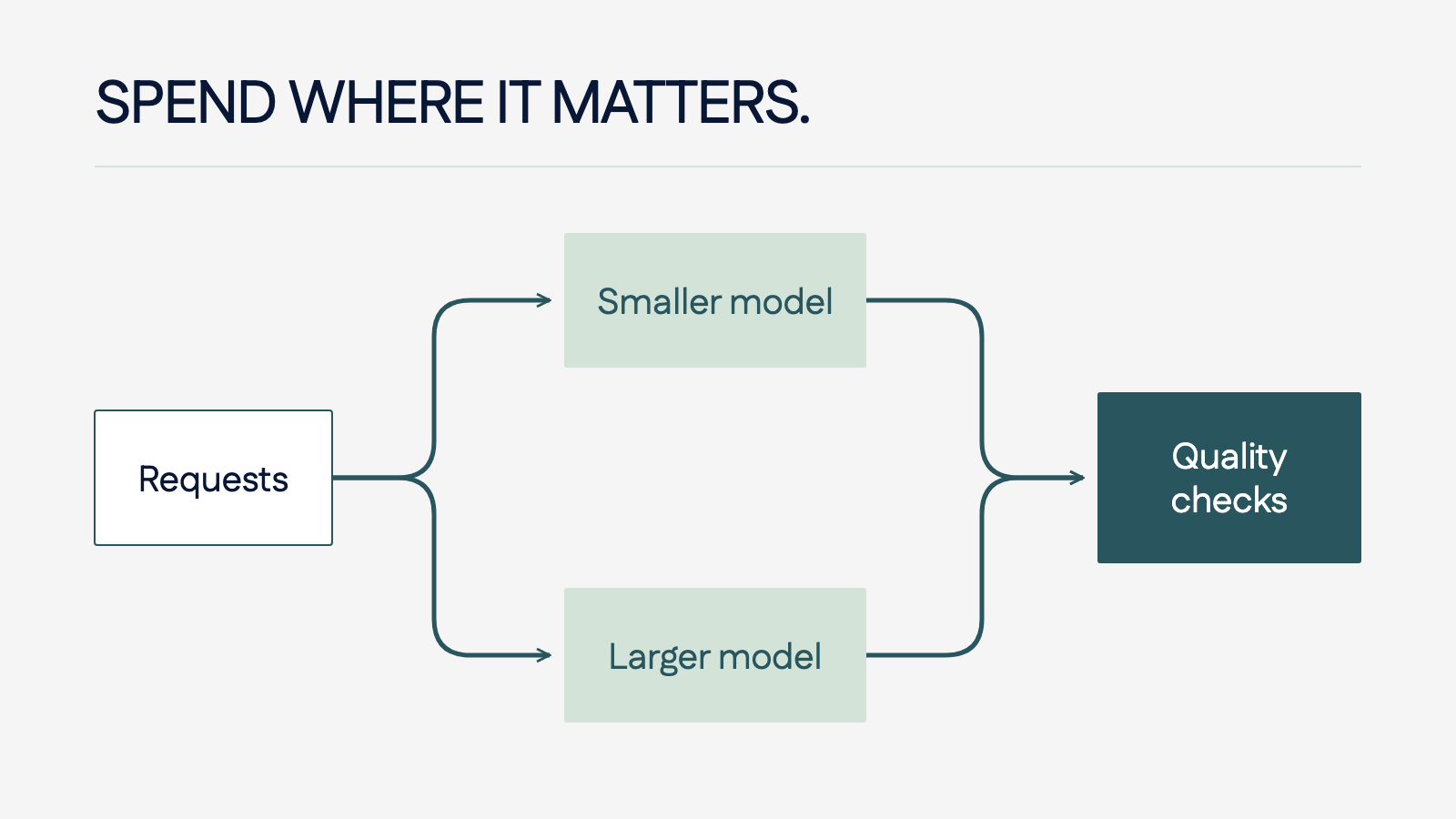
LLM cost control is now a CFO and CTO problem. The fastest way to cut AI spend is not to downgrade every model or cap usage. It is to remove waste while keeping the output quality your users rely on. In production deployments, layered AI cost optimization (caching, model routing, prompt discipline, batching, summarization, and fine-tuning) can meaningfully reduce token spend on premium models while keeping responses accurate. This playbook shows how to estimate the savings, pick the right tactic, and connect the work to a broader AI strategy or AI platform roadmap.
Tokens are the core units that AI models process: every prompt, response, tool definition, retrieved document, and conversation history depends on them. With AI usage surging in 2026, disciplined token optimization can significantly reduce expenses while keeping your applications running smoothly. Teams running production workloads on our AIConsole platform consistently apply these patterns to keep monthly token bills predictable.
Article Outline
- What Are Tokens and How Do They Drive AI Model Costs?
- Why Is Token Optimization Essential for Controlling AI Expenses?
- How Does OpenAI's Pricing Model Impact Input and Output Tokens?
- What Prompt Engineering Best Practices Optimize Token Usage?
- How Can Caching Reduce Token Consumption in API Calls?
- What Tactics Help Select Cost-Efficient AI Models?
- How Does Retrieval-Augmented Generation (RAG) Cut Token Usage?
- What's the Role of Batching in Optimizing AI Application Costs?
- How Does Fine-Tuning Enable Long-Term Token Savings in Language Models?
- What Tools and Monitoring Practices Keep AI Token Spend in Check?
AI token cost calculator: a simple CFO view
Before optimizing, put the problem into a monthly run-rate model. Multiply requests by average input tokens, average output tokens, model price, and cache hit rate. This quick table shows where savings usually come from.
| Cost lever | What to measure | Typical saving path | Best next step |
|---|---|---|---|
| Prompt length | Average input tokens per call | Remove duplicated policy text and unused examples | Prompt compression |
| Output length | Average output tokens per call | Use schemas, bullet limits, and stop conditions | Structured outputs |
| Repeated context | Cache hit rate on system prompts | Reuse stable instructions and tool definitions | Prompt caching |
| Task complexity | Share of calls sent to premium models | Route simple tasks to smaller models | Model routing |
| Stable repetitive work | Few-shot examples sent on every call | Move examples into weights or adapters | LLM fine-tuning |
If your workflow includes regulated financial data, digital assets, or on-chain transaction review, pair token optimization with the right system architecture. See our FinTech software development and blockchain development services pages for adjacent implementation patterns.
What Are Tokens and How Do They Drive AI Model Costs?
Tokens are the building blocks of AI models, representing roughly 4 characters or 0.75 words in English. Every interaction in generative AI (prompts, responses, context) gets broken down into tokens, directly affecting the number of tokens processed and your overall costs. A simple query might use 20 tokens, but complex tasks with long contexts can rack up thousands. Understanding how tokens work is critical for effective token management, since both input and output tokens drive pricing. Models like OpenAI's GPT series use byte-pair encoding to process them efficiently.
Non-English text often requires more tokens, increasing costs by 20-30%, a real challenge for global applications. The number of input and output tokens not only sets your bill but also impacts performance: exceed token limits and processing stops. Best practices focus on reducing unnecessary tokens to lower the token count, keeping cost efficiency aligned with quality. In 2026, with frontier models handling up to 1 million tokens of context, managing tokens per query is vital for balancing depth and cost control in AI applications.
Context length matters too. Longer histories mean more tokens consumed, which can significantly increase costs if not carefully managed. Efficient AI requires strategies to optimize token usage, keeping cloud costs manageable while delivering robust results.
Why Is Token Optimization Essential for Controlling AI Expenses?
Token optimization is non-negotiable because unchecked token usage sends costs soaring in generative AI solutions. While per-token prices have dropped sharply over the past two years, scaling usage still drives up total spend. Optimizing token count is how you achieve significant cost savings while maintaining performance. For businesses, this means focusing on reducing tokens per API call, especially since input token costs often outweigh outputs in repetitive workflows. Without optimization tactics, verbose prompts waste tokens, inflate bills, and make token optimization critical for sustainable operations.
Practical tactics like concise prompting and context pruning can cut token usage by 40-50%, directly boosting AI cost optimization. The win is twofold: lower bills and faster responses, since fewer tokens mean shorter processing time. For AI agents in enterprise settings, disciplined token management prevents budget overruns and lets you scale AI applications without runaway costs. As generative AI adoption grows, this discipline keeps cost-effective AI aligned with your business goals. Customers running our agentic commerce solutions see this firsthand: routing high-volume conversational traffic through optimized prompts is what makes per-conversation economics work.
Token efficiency also ties to broader cloud cost control: lower usage reduces infrastructure demands. Across production AI workloads we work with, layered optimizations routinely deliver double-digit percentage reductions in token spend, underscoring the importance of disciplined token management for long-term cost control.
How Does OpenAI's Pricing Model Impact Input and Output Tokens?
OpenAI and Anthropic both charge per token, with input tokens cheaper than outputs. As of May 2026, GPT-5.5 costs $5 per million input tokens versus $30 per million output tokens, with cached input dropping to $0.50 per million. The gap between input and output pricing pushes you to think hard about which tokens you actually need to generate.
Cached inputs reduce repeated context to a fraction of standard rates, allowing prompt prefixes to be reused without full reprocessing. That changes the math on chatbots, RAG systems, and agent loops where the same system prompt and tool definitions get sent on every turn.
Inputs cover prompts and context; outputs are the generated responses. Fine-tuning adds complexity but reduces token usage long-term by tailoring models to specific tasks, removing the need for verbose few-shot examples on every call.
Per-token pricing also encourages tactics like batching, which offers a 50% discount on non-urgent OpenAI workloads, optimizing high-volume use cases.
Pricing snapshot (May 2026)
Last updated: May 2026. Always verify current pricing on the official provider pages.
| Model | Input ($ / 1M) | Output ($ / 1M) | Cached input ($ / 1M) |
|---|---|---|---|
| GPT-5.5 | $5 | $30 | $0.50 |
| GPT-5 Nano | ~$0.05 | ~$0.40 | ~$0.005 |
| Claude Opus 4.7 | $5 | $25 | $0.50 |
| Claude Sonnet 4.6 | $3 | $15 | $0.30 |
| Claude Haiku 4.5 | $1 | $5 | $0.10 |
| Gemini 2.5 Flash | low single digits | low single digits | fractional |
For authoritative cost guidance, see the OpenAI cost optimization guide.
Model cost comparison (May 2026)
Picking the right model for each task class is the single biggest cost lever after caching. The table below compares the workhorse models most production teams actually deploy.
| Model | Input ($ / 1M) | Output ($ / 1M) | Cached input | Best for |
|---|---|---|---|---|
| GPT-5.5 | $5 | $30 | $0.50 | Hard reasoning, complex coding, long-horizon agents |
| GPT-5 Nano | ~$0.05 | ~$0.40 | ~$0.005 | Classification, routing, short extractive answers |
| Claude Opus 4.7 | $5 | $25 | $0.50 | Deep reasoning, multi-step coding, financial analysis |
| Claude Sonnet 4.6 | $3 | $15 | $0.30 | Default workhorse: RAG, chat, content generation |
| Claude Haiku 4.5 | $1 | $5 | $0.10 | High-volume tagging, summarization, simple tool use |
What Prompt Engineering Best Practices Optimize Token Usage?
Prompt engineering best practices revolve around crafting concise, targeted prompts to minimize token usage while keeping output quality high. By cutting fluff and using precise instructions, teams can typically reduce token count by 30-50%. Streamlined chain-of-thought prompting balances depth with efficiency, keeping input tokens in check.
Iterative refinement is the practical method: test prompts, track tokens consumed, refine for brevity. This optimizes token usage in AI models, especially for repetitive tasks where small tweaks compound into meaningful savings. Using system prompt terms to guide outputs avoids extra input and output tokens, improving cost efficiency in OpenAI API integrations.
Advanced techniques (placeholders, summarized history, reusable instruction blocks) further reduce tokens processed. The same approach also improves the balance of performance and cost in generative AI applications.
Shrinking output tokens with structured outputs
Forcing the model to emit structured JSON via OpenAI's response_format with a strict schema typically cuts output tokens by 30% or more, because the model stops emitting prose wrappers and explanations.
from openai import OpenAI

client = OpenAI()

resp = client.chat.completions.create(
    model="gpt-5.5",
    messages=[{"role": "user", "content": "Extract company and risk score from: 'Acme Corp scored 7.2/10.'"}],
    response_format={
        "type": "json_schema",
        "json_schema": {
            "name": "RiskExtraction",
            "strict": True,
            "schema": {
                "type": "object",
                "additionalProperties": False,
                "properties": {
                    "company": {"type": "string"},
                    "risk_score": {"type": "number"},
                },
                "required": ["company", "risk_score"],
            },
        },
    },
)
print(resp.choices[0].message.content)
How Can Caching Reduce Token Consumption in API Calls?
Caching reuses context across calls, cutting token consumption by avoiding redundant input tokens. With both OpenAI and Anthropic, cached inputs cost roughly 10% of standard rates, delivering 75-90% savings on repetitive queries. This matters most for AI applications like chatbots and agents, where the same system prompt and tool definitions get sent on every turn.
Anthropic's prompt caching, exposed via cache_control on system messages, stores frequent prefixes for the duration of the session. The Anthropic docs cover the full mechanics: Anthropic prompt caching.
import anthropic

client = anthropic.Anthropic()

response = client.messages.create(
    model="claude-sonnet-4-6",
    max_tokens=1024,
    system=[
        {
            "type": "text",
            "text": "You are a financial analyst for a tier-one bank. Follow the policy below.\n\n" + LONG_POLICY_TEXT,
            "cache_control": {"type": "ephemeral"},
        }
    ],
    messages=[
        {"role": "user", "content": "Summarize Q1 risk exposure for Acme Corp."}
    ],
)
print(response.content)
Time-based cache expiration keeps stale data from leaking into outputs while still capturing the savings on hot prefixes. Caching is a cornerstone of AI cost optimization on chat and agent workloads where the same long prefix is reused on every turn, and switching it on is typically the highest-leverage single change a team can make to monthly token spend.
What Tactics Help Select Cost-Efficient AI Models?
Choosing the right AI model means cascading: route simple tasks to budget models like GPT-5 Nano (~$0.05 per million input tokens) or Claude Haiku 4.5 ($1 per million), and reserve premium models like GPT-5.5 or Claude Opus 4.7 for genuinely hard work. This pattern routinely cuts token costs by 60%, since lighter models use fewer tokens and respond faster while meeting quality requirements for the bulk of traffic.
Evaluate models on real workload samples, not synthetic benchmarks. Open-source options like Llama 3.1 offer near-zero inference costs after setup, ideal for self-hosting when latency and data residency matter. Hybrid approaches, combining hosted and self-hosted models, give you a longer cost lever. Monitoring tools track tokens per model so you can refine routing decisions in production. For organizations evaluating which workloads belong on which model class, our AI strategy engagements typically surface 30-50% cost reductions just by re-routing existing traffic.
def route_model(prompt: str, complexity_hint: str | None = None) -> str:
    """Route a request to the cheapest model that can handle it."""
    token_estimate = len(prompt) // 4  # rough char to token heuristic

    if complexity_hint == "hard" or token_estimate > 4000:
        return "claude-opus-4-7"

    if token_estimate > 500 or complexity_hint == "medium":
        return "claude-sonnet-4-6"

    # Short, simple queries: tagging, classification, routing.
    return "gpt-5-nano"


model = route_model("Classify the sentiment of this review: 'Loved it.'")
# Returns "gpt-5-nano", roughly 100x cheaper than Opus on the same call.
How Does Retrieval-Augmented Generation (RAG) Cut Token Usage?
Retrieval-Augmented Generation (RAG) reduces token usage by fetching only relevant external data, shrinking prompt sizes from thousands to hundreds of tokens. This significantly lowers input token costs, especially when long contexts would otherwise drive up expenses. For AI applications, RAG cuts bloated prompts and routinely delivers 70% token savings.
Vector databases provide fast retrieval that keeps outputs focused without padding the prompt with irrelevant context. RAG also improves accuracy and reduces hallucination risk, which is why it remains the default architecture for knowledge-heavy tasks in production AI systems.
What's the Role of Batching in Optimizing AI Application Costs?
Batching groups requests to earn 50% discounts on OpenAI, reducing cost per token for non-urgent tasks. Batching processes many requests at once, ideal for analytics, content generation, and overnight scoring jobs where speed isn't critical. For generative AI, async batching optimizes API spend, lowering bills by 30-40% in large-scale deployments. Best practice: schedule batches during off-peak hours for additional latency headroom.
Batching shines for predictable AI applications like nightly report generation or customer insight pipelines, reducing the number of synchronous API calls and unlocking the provider discount. The result: lower cost per output without giving up output quality.
from openai import OpenAI

client = OpenAI()

# 1. Upload a JSONL file with one request per line.
batch_file = client.files.create(
    file=open("requests.jsonl", "rb"),
    purpose="batch",
)

# 2. Submit the batch (50% discount on non-urgent workloads).
batch = client.batches.create(
    input_file_id=batch_file.id,
    endpoint="/v1/chat/completions",
    completion_window="24h",
)

# 3. Poll for completion, then download results.
status = client.batches.retrieve(batch.id)
if status.status == "completed":
    output = client.files.content(status.output_file_id)
    with open("results.jsonl", "wb") as f:
        f.write(output.read())
Planning workflows around provider discounts and off-peak windows is the operational lever. The approach reduces token spend and streamlines AI interactions, making it a vital tactic for managing costs in advanced AI models in 2026.
How Does Fine-Tuning Enable Long-Term Token Savings in Language Models?
Fine-tuning customizes AI models for specific use cases, reducing the number of tokens needed by embedding task knowledge directly into the model. Fine-tuning has an upfront cost, but inference savings can hit 60% by streamlining input and output tokens. The model generates precise outputs without lengthy few-shot prompts, boosting token efficiency for repetitive workloads.
For consistent, high-volume tasks fine-tuning can substantially cut per-call token usage by removing the need for verbose few-shot examples, often delivering meaningful month-over-month reductions in inference spend. Fine-tuning also improves the balance of performance and cost, since optimized models handle complex queries with minimal input tokens. The strategy fits consistent use cases like customer support, structured extraction, or content generation, where upfront training cost yields long-term reductions in token spend.
Combining fine-tuning with prompt engineering compounds the savings, keeping language models running with disciplined token management and predictable cloud costs across production AI applications.
What Tools and Monitoring Practices Keep AI Token Spend in Check?
Monitoring tools like Helicone and LangChain offer real-time insights into token usage, helping pinpoint inefficiencies in AI interactions. These platforms track the number of tokens used per API call, enabling 30% reductions in token consumption through targeted tweaks. Setting token limits via an AI gateway prevents runaway costs in OpenAI and other generative AI deployments.
Regular audits and alerts for unusual token spikes catch wasteful prompts early. In our experience, simply standing up a token-usage dashboard surfaces enough easy wins (verbose system prompts, oversized context windows, the wrong model on a hot path) to drive a noticeable reduction in monthly spend. The same tools surface cost drivers per use case, so you can target optimization where it actually moves the bill.
Pairing monitoring with caching and RAG builds a durable framework for managing costs. The combination keeps AI solutions cost-effective, with fewer tokens driving real cost savings while keeping performance steady in advanced AI systems.
Key Takeaways for AI Token Optimization
- Grasp token basics: Tokens drive AI model costs; minimizing unnecessary input and output tokens ensures cost efficiency.
- Master prompt engineering: Concise prompts cut token count by 30-50%, optimizing OpenAI API usage for generative AI.
- Use caching: Reuse context to slash input token costs by 75-90%, ideal for repetitive AI tasks like chatbots.
- Cascade models: Route simple tasks to budget models like GPT-5 Nano or Claude Haiku 4.5 to save 60% on token spend, balancing performance and cost.
- Leverage RAG: Reduce prompt sizes by 70% with Retrieval-Augmented Generation, lowering input token costs for complex tasks.
- Batch requests: Group API calls for 50% discounts, cutting cloud costs by 30-40% in non-urgent AI workloads.
- Invest in fine-tuning: Reduce token usage by 50-75% long-term for consistent use cases, saving on inference costs.
- Monitor usage: Tools like Helicone track token spend, enabling real-time optimizations and cost control.
- Combine strategies: Integrate caching, RAG, and batching for 40-70% cost savings while maintaining AI performance.
- Stay proactive: With 2026's evolving AI token costs, regularly review pricing models to refine optimization tactics.
By applying these token optimization strategies, you can significantly reduce AI costs and run scalable, cost-effective AI solutions that drive business value without breaking the budget.
Put AI to work in your business.
Identify where AI can make a measurable difference to your operations.
Talk to our team